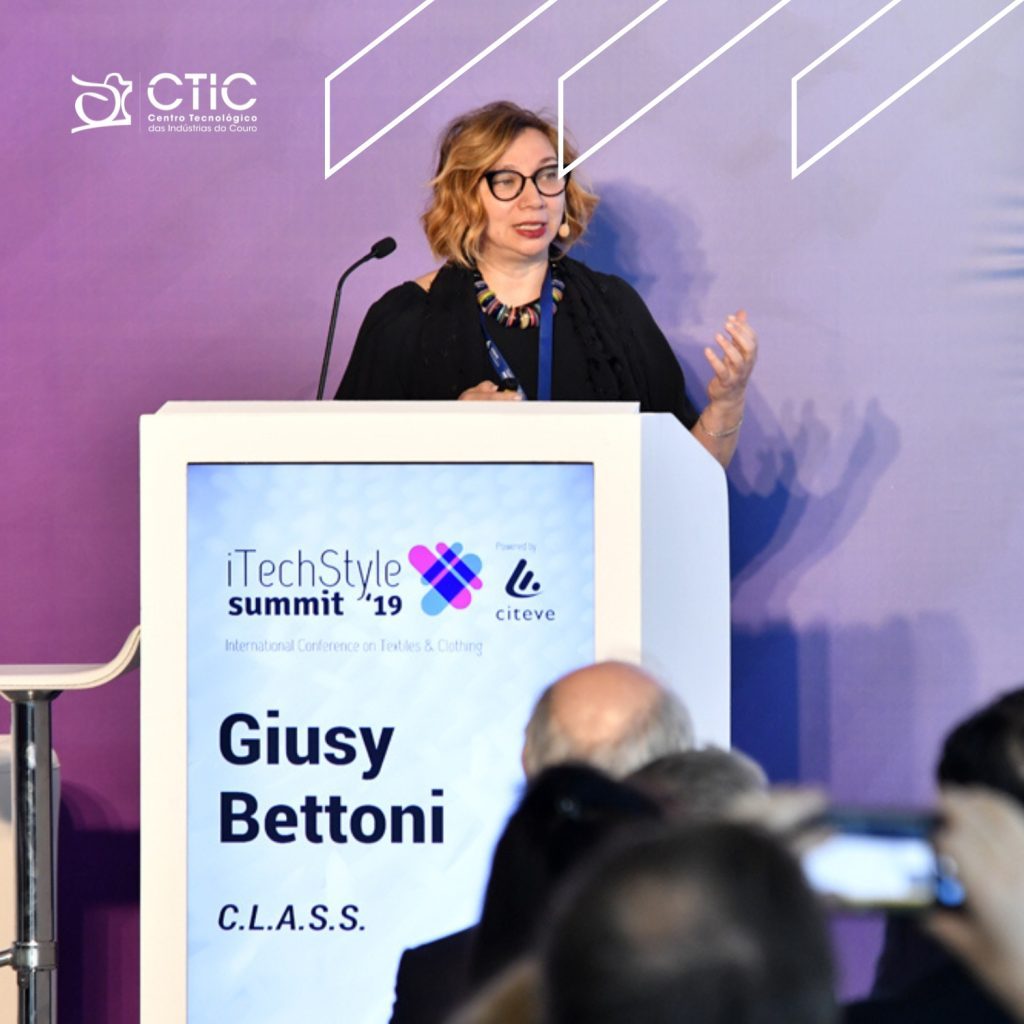
Interview with Giusy Bettoni (C.L.A.S.S.)
“When We Talk About Sustainability, We Should Talk About Knowledge”
Talking about sustainability has become easy — perhaps too easy. Over the past few years, the term has come to dominate the discourse of almost every industrial sector, often turning into little more than a marketing tool.
Paradoxically, this trivialization has made it more difficult to recognize those who have been working on sustainability in a genuine and consistent way for decades — as is the case with many European production sectors, including the tanning industry. While some companies continuously invest in improving their processes and environmental practices, others stand out simply because of their ability to promote a “green” image, fueling greenwashing practices.
But how can the industry escape this cycle?
This was one of the questions addressed to Giusy Bettoni, CEO of C.L.A.S.S., an international communication and innovation hub that seeks to redefine how sustainability is understood and communicated throughout the fashion supply chain.
“The Problem Is the Lack of Knowledge”
A study conducted by the International Consumer Protection and Enforcement Network (ICPEN) found that up to 42% of online sustainability claims are “exaggerated, false, or misleading.” According to Giusy Bettoni, this highlights a central issue:
“When we talk about sustainability, we should talk about knowledge. Unfortunately, in most cases, that knowledge does not exist.”
According to Bettoni, sustainability cannot be reduced to a superficial trend or concept. On the contrary, it is a complex system involving companies, processes, products, and consumers.
“The real challenge is to put all of this into practice and communicate that knowledge authentically.”
Between the narrative and Greenwashing
For Giusy Bettoni, there is now a fundamental difference between “telling stories” and “creating stories.” When communication is not grounded in concrete reality, the risk of falling into greenwashing becomes inevitable. At the same time, many companies carrying out serious and innovative work often struggle to communicate their true value effectively.
“There are many companies with incredible stories to tell, but they are unable to share them.”
This “silence of sustainability,” as she describes it, mainly affects European and Japanese companies, where there is a strong technical foundation and a genuine commitment to sustainable practices, but little ability to translate that complexity into language that is accessible to consumers.
Sustainability or “Responsible Innovation”?
Given the growing overuse of the term “sustainability,” Giusy Bettoni believes it may be necessary to adopt a new language.
“Today, it may be more accurate to speak about responsible innovation.”
However, she stresses that this responsibility must be continuously demonstrated and measured.
“We cannot be generic. If a company speaks about traceability, then it must prove it with transparency, honesty, and clarity.”
In her view, a truly sustainable strategy should be built upon four fundamental pillars:
- Design
- Innovation
- Responsibility
- Communication
Only the combination of these elements can transform sustainability into a concrete tool for business value.
The Challenge Facing the Leather Industry
The conversation also addressed the public perception of leather, a particularly relevant issue for the European tanning industry. Despite significant advances in circularity, traceability, and environmental control, many consumers still associate leather exclusively with animal welfare concerns.
For Giusy Bettoni, this perception requires an extremely careful and transparent approach.
“We need to clearly explain everything behind leather: an industry that, particularly in Europe, has demonstrated a historic and pioneering commitment to sustainability.”
According to the CEO of C.L.A.S.S., changing this perception inevitably depends on open dialogue throughout the entire production chain.
“We need to be authentic, transparent, and communicate more.”